 Richard Pikmets
Not every cookie needs consent. The Estonian Data Protection Inspectorate splits website cookies into two groups: essential and additional. Here is where the line is, what valid consent looks like and how to review the cookies on your own website.
In short
Essential
They support core website functions, such as session and language preference cookies. No consent is asked for them.
Additional
Analytics, advertising and authentication cookies that can identify a person. Prior, voluntary consent is required.
Consent must be informed
Visitors need to know what the cookies do and how long they last. They must be able to withdraw consent just as easily.
This article is a practical overview, not legal advice. The grouping and the consent requirements come from the Estonian Data Protection Inspectorate (AKI) and the European Data Protection Board (EDPB) guidelines.
When do cookies need consent?
The requirement comes from the ePrivacy Directive (2002/58/EC), specifically Article 5(3). The same paragraph contains an exemption. Consent is not needed if storing the information is solely for carrying out the transmission of a communication over an electronic communications network, or if it is strictly necessary to provide a service that the user has explicitly requested.
Essential and additional cookies
Essential cookies
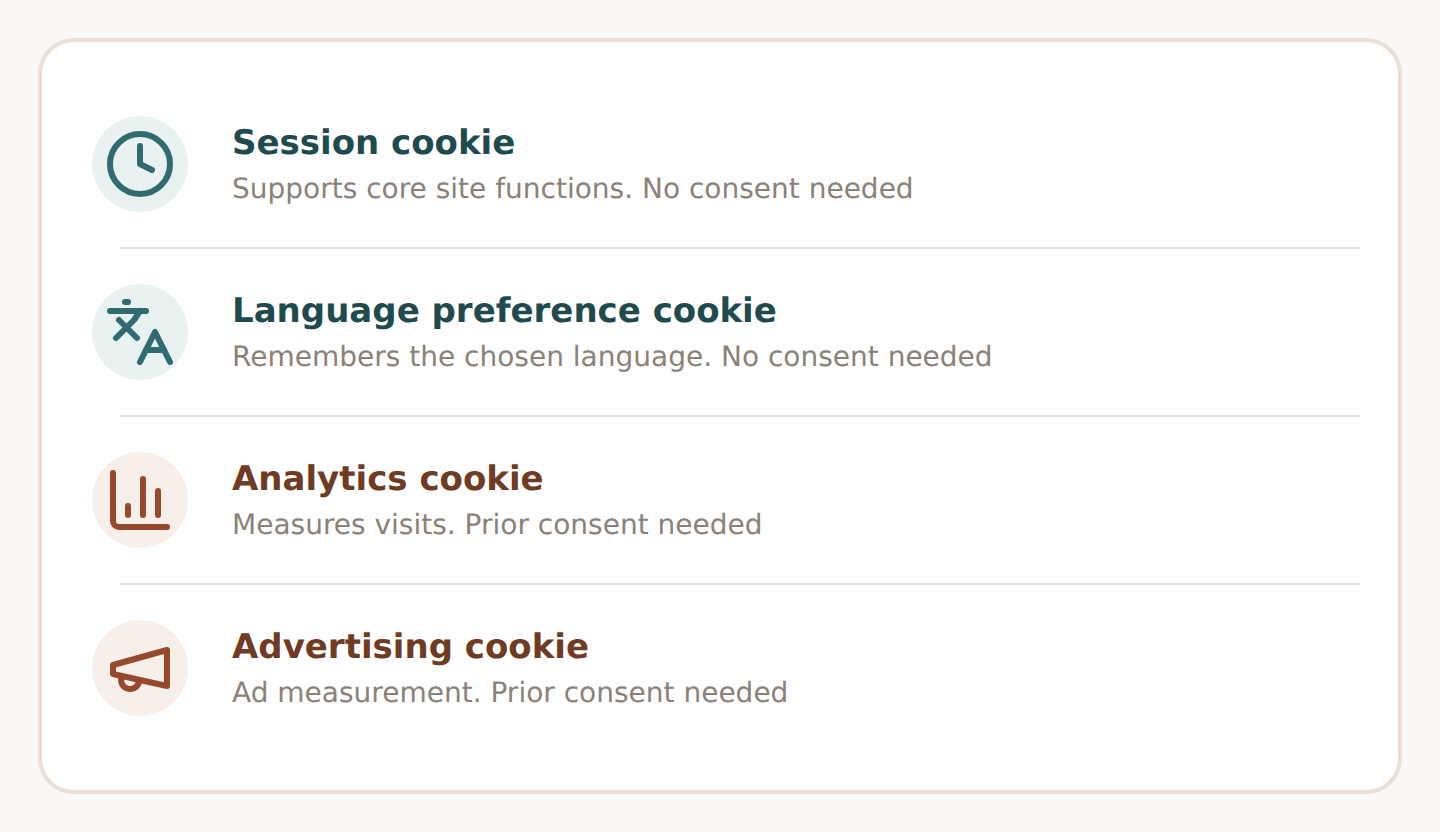
These support the core functions of a website. AKI gives session and language preference cookies as examples. Such cookies do not measure anything directly. You do not need to ask for consent for them.
Additional cookies
This group covers analytics, advertising and authentication cookies that can identify a person directly or indirectly. Installing them requires the visitor’s prior, voluntary consent. In practice, that means cookies from GA4, Google Ads or Meta Pixel, for example, are not installed until the visitor has given consent. Whether your setup identifies visitors needs to be checked case by case.
What counts as valid consent?
In case C-673/17, the Court of Justice of the EU ruled that consent for cookies must meet the conditions of Article 4(11) and Article 7 of the General Data Protection Regulation (GDPR). According to AKI, four things follow from this:
- consent is prior and voluntary;
- the visitor knows all the circumstances, including how long the cookies last and whether third parties can access them;
- this information is provided in the website’s privacy terms;
- consent can be withdrawn as easily as it was given.
Cookies are not the only technology
According to EDPB Guidelines 2/2023, Article 5(3) is not limited to cookies. It covers any storage of information on a user’s device and any access to information already stored there, such as local storage. The guidelines also analyse tracking pixels and unique identifiers separately. The EDPB stresses that exemptions must be assessed case by case, taking into account national law and the guidance of the national supervisory authority. So a list of cookies is not enough: review everything that gets stored on the visitor’s device.
How do you review the cookies on your website?
- Open your website in a private browser window and do not give consent.
- Use the browser’s developer tools to see which cookies have already been stored.
- Split them into two groups: essential and additional.
- Check that each additional cookie appears only after consent is given.
- Give consent and see what gets added.
- Withdraw consent and check that the choice takes effect.
- For each cookie, write down its name, purpose, duration and whether third parties can access it.
Practical tip
You need the same information for your privacy terms and for consent to be informed. Make the cookie list early on and keep it up to date.
Which CMP should you use?
A consent banner needs a CMP (Consent Management Platform). If you don’t have a working solution yet and need a managed CMP with Google Consent Mode support, one practical option is Cookiebot by Usercentrics. A CMP does not guarantee that tags behave correctly once it is installed, so test it with real usage scenarios.
Affiliate note: the Cookiebot by Usercentrics link is an affiliate link. If you sign up through it, I may earn a commission; your price does not change.
Frequently asked questions
Does Google Analytics need consent?
According to AKI, analytics cookies that can identify a person directly or indirectly need prior consent. Whether your setup does so has to be checked separately. For the technical side, read Cookie Consent and Consent Mode.
Does a language preference cookie need consent?
AKI names the language preference cookie as an example of an essential cookie. Such a cookie supports the core functions of a website and does not measure anything directly.
Can consent be withdrawn?
Yes. According to AKI, it must be possible to withdraw consent as easily as it was given.
If you need help setting up the consent banner, Consent Mode and tags, see the Cookie Consent setup service. You can get a quick overview with the free Cookie Consent checklist. For tags, also read about Google Tag Manager.
Sources
- Estonian Data Protection Inspectorate: Internet and web activities (cookies, in Estonian)
- EDPB: Guidelines 2/2023 on Technical Scope of Art. 5(3) of ePrivacy Directive, version 2.0 (7 October 2024)
Facts checked against official documentation on 29 September 2026.


