 Richard Pikmets
ChatGPT ads open up a new advertising channel for businesses, where the user’s need isn’t described by a single search term but often by the context of a whole conversation. In this guide, I explain how ChatGPT Ads works, how it differs from Google Ads and when it might make sense for an Estonian business to test the channel with a controlled budget.
In short
Available in Estonia
Self-service access to OpenAI Ads Manager is currently available in Estonia.
Context, not exact match
Ad relevance is shaped by the conversation’s context, intent and the advertiser’s context hints.
Start with a test
With a new channel, check tracking, ad messaging and the real business result before increasing the budget.
With ChatGPT ads, the easiest wrong conclusion is that it’s just another variation of Google Ads or Meta ads. In reality, the context of use is different. Before seeing an ad, a person may already have spent several messages discussing their problem, options and constraints with ChatGPT. So it’s not just the ad itself that matters. Just as important is the conversational situation in which the offer becomes relevant to the user.
What are ChatGPT ads?
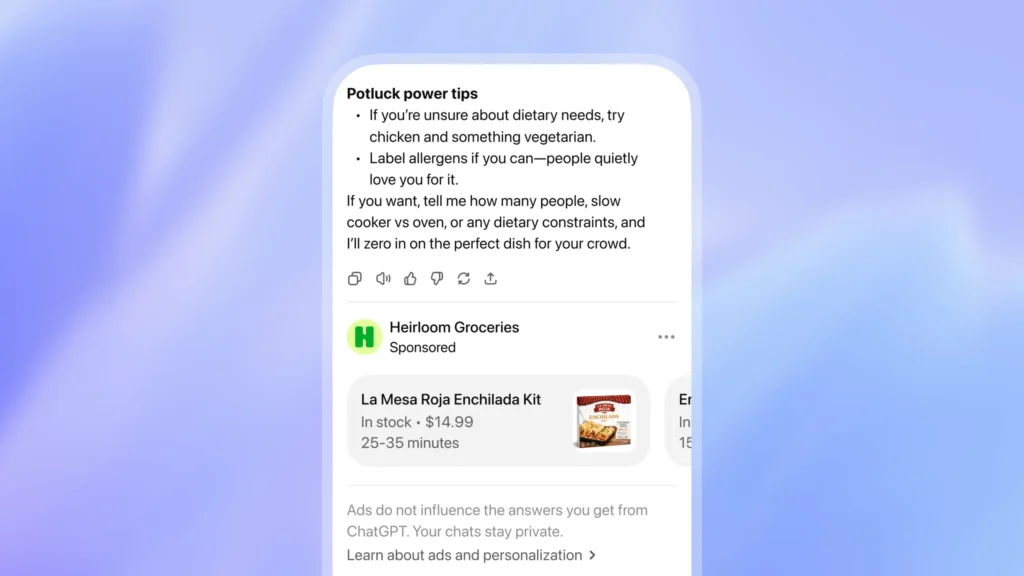
ChatGPT Ads is OpenAI’s advertising platform, through which a business can create campaigns and ads that may be shown to ChatGPT users. The ad is a sponsored placement separate from ChatGPT’s answer. Advertisers can’t pay to have ChatGPT’s answer changed in their favour or to be ranked higher in the answer.
According to OpenAI, eligible users on the Free and Go plans may see ads. The Plus, Pro, Business, Enterprise and Edu plans are ad-free, and ads aren’t shown to accounts identified as under 18.
Are ChatGPT ads available in Estonia?
Yes. According to OpenAI’s current Ads Manager availability page, Estonia is on the list of countries for the self-service Ads Manager. This means an Estonian advertiser can create an Ads Manager account and manage campaigns themselves. As the platform is still in beta and OpenAI is expanding features quickly, always check what your account can currently do before planning a campaign.
Where and to whom are ChatGPT ads shown?
An ad may appear below ChatGPT’s answer as a separate sponsored block. Whether it’s shown depends on whether the user, the conversation and the ad are eligible for the specific campaign. The ad is visually separated from the answer and the user can see that it’s sponsored content.
With ChatGPT ads, the most important question isn’t “which keyword do I buy?”, but “in which conversation is my offer genuinely relevant to the user?”.
How does ChatGPT ad targeting work?
OpenAI describes ad selection as a system that takes into account, among other things, the context and intent of the current conversation, the ad’s landing page, headline and text, and the context hints added by the advertiser. If the user has ad personalisation turned on, selected data from their earlier ChatGPT use may also affect relevance.
Google Search
The user types a specific search query. The advertiser works with keywords, search terms and search intent.
ChatGPT Ads
The user may describe their need across several messages. The advertiser works with topics, conversational situations, intent and context hints.
What are context hints?
At ad group level, the advertiser can add context hints that describe conversations, topics or keywords where their product or service could be relevant. They help the ad system understand relevance, but OpenAI stresses that they are not exact match keywords and don’t guarantee the ad will be shown in a specific conversation.
For example, an advertiser selling CRM software could think not just about the word “CRM”, but about situations such as:
- choosing a CRM for a small sales team;
- moving the sales pipeline out of Excel;
- improving lead management;
- automating the sales process;
- comparing CRMs against a specific company’s needs.
That way, you think more about the user’s problem, not just a keyword list.
Which campaign objectives does ChatGPT Ads support?
In Ads Manager, you can currently choose between CPM, CPC and conversion-optimised CPC (oCPC) objectives.
CPM / Reach
Suitable for increasing visibility and reach. Billing is per thousand impressions.
CPC / Clicks
Suitable when the goal is to bring users from the ad to a website or product. Billing is per valid click.
oCPC / Conversions
Looks for clicks that are likely to end in the chosen conversion. Billing is still per click, not per conversion.
To use oCPC, conversion tracking has to be set up correctly in Ads Manager. If tracking is unreliable, it doesn’t make sense to let automation optimise on data you don’t trust yourself. The same principle applies to conversion tracking on other ad platforms.
What does a ChatGPT ad look like?
An ad unit can include the advertiser’s name, a headline, a description, a landing page and an image. In practice, I wouldn’t recommend creating just one ad and then waiting for the platform to “find the right people”. With a new channel, it’s more useful to test several genuinely different messages.
- a problem-based message: what problem you solve;
- an outcome-based message: what change you offer;
- a comparison-based message: why your solution differs from the alternatives;
- a lower-risk message: a demo, audit, calculator or another simpler next step.
ChatGPT Ads vs Google Ads
I don’t currently see ChatGPT Ads as a replacement for Google Ads. They reach users in different situations and can therefore play different roles in the funnel.
| Topic | Google Search | ChatGPT Ads |
|---|---|---|
| Where the need becomes clear | Search query | Conversation context and intent |
| What the advertiser provides | Keywords, search terms, ads | Context hints, ad groups, ads |
| Intent | Often very specific and search-based | May develop over a longer conversation |
| Platform maturity | Very mature, lots of historical data | New beta channel, few benchmarks |
| Optimisation | Highly developed bid strategies and conversion tracking | CPM, CPC and oCPC; features are evolving quickly |
| Role in my view | The main channel for reaching people already searching for your service | A complementary channel worth evaluating as a controlled test |
If Google Ads already works for your business, adding ChatGPT Ads doesn’t mean you should sharply cut the budget of a channel that works. It’s better to give the new channel a separate test budget and compare how good the visits and conversions from it really are.
Which businesses might ChatGPT Ads suit?
Since users may discuss their problem in some depth in ChatGPT before seeing an ad, I see opportunities mainly for offers where people do research or compare solutions before choosing.
- B2B services and software;
- SaaS and technology products;
- professional services;
- training and knowledge-based services;
- more complex or expensive products that people seek advice on before choosing;
- businesses with a strong landing page and working tracking.
It’s a less certain test when the offer is very local, has a very small margin, or the business can’t yet reliably measure conversions even from its existing ad channels. In that case, I’d sort out the basic tracking and landing page issues first.
How I’d set up a ChatGPT ads test
- Choose one business goal. Do you want enquiries, demo sign-ups, purchases or relevant visitors?
- Build a context map. In which conversational situations could your solution be genuinely relevant?
- Split contexts into separate ad groups. Don’t cram very different use cases into one group.
- Create 3–5 genuinely different ad variants. Test different messages, not just word order.
- Check the landing page. The ad’s promise has to continue on the page, and the next step has to be clear.
- Set up UTMs and conversions. You can’t judge a new channel’s value on clicks alone.
- Only increase the budget once you know what works. If the context, ad or landing page isn’t working, a bigger budget won’t solve the problem.
How to measure ChatGPT ad results
Ads Manager gives a campaign-level overview of impressions, clicks, spend, CTR, CPC or CPM and, if conversions are set up, downstream results. I’d look at these numbers together with web analytics and the real business result.
- whether the click reaches the right landing page;
- whether UTMs distinguish ChatGPT Ads from other channels;
- whether the form, purchase or other conversion fires correctly;
- whether the sales team rates the lead quality as good enough;
- whether CPA or another business metric is comparable with alternative channels.
How much do ChatGPT ads cost?
It wouldn’t be sensible to promise one universal CPC or CPM price for ChatGPT Ads. The actual price depends on the campaign objective, the auction, the market, ad relevance and available ad inventory. With a new platform, don’t carry Google Ads or Meta benchmarks over one-to-one.
According to OpenAI’s documentation, you can use either a total campaign budget or a daily budget, and the daily minimum depends on the account’s billing currency. For an Estonian account billed in euros, the minimum daily campaign budget currently shown in Ads Manager is €15. As the platform changes quickly, always check the current minimum shown in your account before creating a campaign.
Is ChatGPT Ads worth testing right now?
For some businesses, yes, but not just because the channel is new. A new channel is valuable when you have a clear offer, a well-understood audience, a proper landing page, tracking and a budget that allows a meaningful test.
To me, the most sensible approach right now is to treat ChatGPT Ads as a controlled experiment. If the data shows that the channel brings good visitors or conversions at a suitable price, the budget can be increased gradually. If not, at least you know which hypothesis was tested and what was learned.
Frequently asked questions
Are ChatGPT ads available in Estonia?
Yes. According to OpenAI’s current Ads Manager availability information, Estonia is among the countries with self-service Ads Manager.
Do ChatGPT ads influence the AI’s answers?
No. According to OpenAI, ads are separate from ChatGPT’s answers, and advertisers can’t pay to have ChatGPT’s answer changed in their favour.
Does ChatGPT Ads use keywords?
Not according to Google Search’s exact match logic. Ad group context hints can describe topics, conversations or keywords, but they help guide relevance and don’t guarantee the ad will be shown in a specific conversation.
Can you track conversions from ChatGPT ads?
Yes. Ads Manager supports conversion tracking, and optimising an oCPC campaign requires reliable conversion tracking. In web analytics, it’s also worth distinguishing visits from ChatGPT Ads with UTM parameters.
Will ChatGPT Ads replace Google Ads?
In my view, no. Google Search is still a very strong channel for reaching people who are already searching for your service. ChatGPT Ads is more of a complementary ad channel worth testing separately for your offer and audience.
What is the minimum daily budget for ChatGPT ads?
According to OpenAI, the daily campaign minimum depends on the account’s billing currency. For an Estonian account billed in euros, the minimum daily budget currently shown in Ads Manager is €15 per campaign. As Ads Manager is in beta and pricing limits may change, always check the current minimum shown in your account when creating a campaign.
Official sources
- OpenAI Ads Manager Availability
- Ads in ChatGPT: The Basics
- Create Campaigns for ChatGPT Ads
- Conversion-optimized Campaigns
- Ads in ChatGPT FAQ
ChatGPT Ads is a rapidly evolving beta platform. The features and limitations described in this article are based on OpenAI’s official documentation available at the time of writing and may change later.