 Richard Pikmets
Content marketing means articles, guides and tools that answer customers’ questions before they buy. Here you will find where to get topics, how to judge whether content is useful and what to track to see whether it brings enquiries.
In short
A question before a topic
Every article answers one question that customers really ask before buying.
Useful, not a lot
Google’s warning sign is a lot of content on many topics made only for search visits.
Track actions
Search Console shows visibility in search, and a GA4 key event shows whether a visitor took a step towards an enquiry.
This article is a practical guide for small businesses that are just starting with content marketing or don’t know whether it works. The rules for useful content come from Google Search Central documentation.
What is content marketing and what is it for?
Content marketing means making useful material: articles, guides, videos, tools and newsletters that help your audience decide before they buy. Good content answers a question the customer asks before buying and leads to the next step: an enquiry, an order or a contact.
Ads reach people who are searching right now or people you show the ad to. Content stays on your site even without an ad budget, and the same page also works as a landing page for Google Ads. I look at content, the landing page and tracking together, not as separate projects.
Where to find topics people really ask about
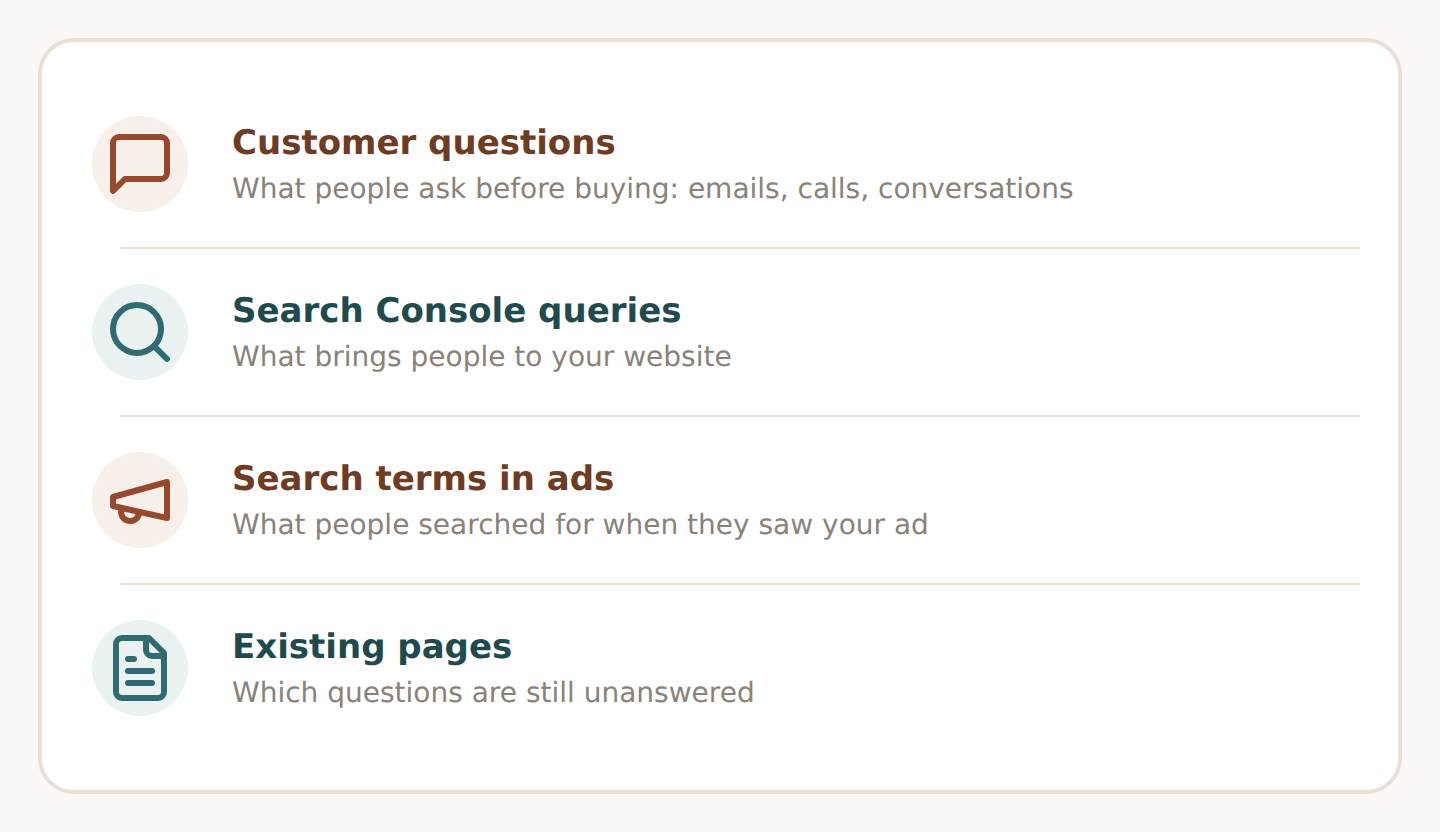
Start with customer questions. I don’t start with a channel or a tool, but with the business result you need and the information you need to manage it. In content marketing that means: what question brings a person to you, and what could they do after reading the answer?
Your own data is the source of topics. I use Search Console and SE Ranking to find topics. In a Google Ads account I check search terms and search intent, and the same queries often make good article topics.
Set the search intent for each topic: the person wants to know, compare or buy. A guide suits knowing, a comparison article suits comparing and a service page suits buying. If two pages answer the same query, it may not be clear to Google which one to show.
Practical tip
Use the words customers use in the article title. If sales conversations keep asking “how much does it cost?”, write a pricing article rather than a general overview.
What makes content useful?
According to Google’s guidance, search systems prefer helpful, reliable information made for people, not to influence search rankings. The guidance lists questions for assessing your own content. In practice there are five things to check:
- Does the text contain original information, analysis or experience?
- Is it thorough, and not a summary of other texts without added value?
- Are the sources and the author visible?
- Will the reader learn enough to reach their goal?
- Would you recommend the text to your own customer?
Google also lists warning signs for content made mainly to attract search visits: many pages on many topics, summaries of other texts with no added value and changing the page date when the content has not changed.
For a small business this means there can be few articles, but each must give an answer. Your advantage is knowledge a generic page doesn’t have: you know your customers’ questions, prices and typical mistakes.
Google’s SEO Starter Guide adds that helpful and interesting content will likely influence your search visibility more than other recommendations. It advises keeping content up to date, removing outdated content and citing reliable sources.
A simple content plan for a small business
Start with a couple of articles that tie directly to your service. The table shows which question each content type solves and where it sends the reader next. The examples are hypothetical.
| Content type | Question it answers | Next step |
|---|---|---|
| Pricing article | “How much does it cost?” | Budget calculator or enquiry form |
| Comparison article | “Which suits me: A or B?” | Service page or consultation |
| Guide | “How do I do this?” | Checklist or related article |
| Tool or checklist | “Is everything in order?” | Service page |
Decide in advance what the reader should do after the article. Without a next step, the article gets read and the tab gets closed.
Link articles to service pages with descriptive anchor text, as Google recommends, for example Google Ads management or conversion tracking, not “read here”.
Checklist before publishing
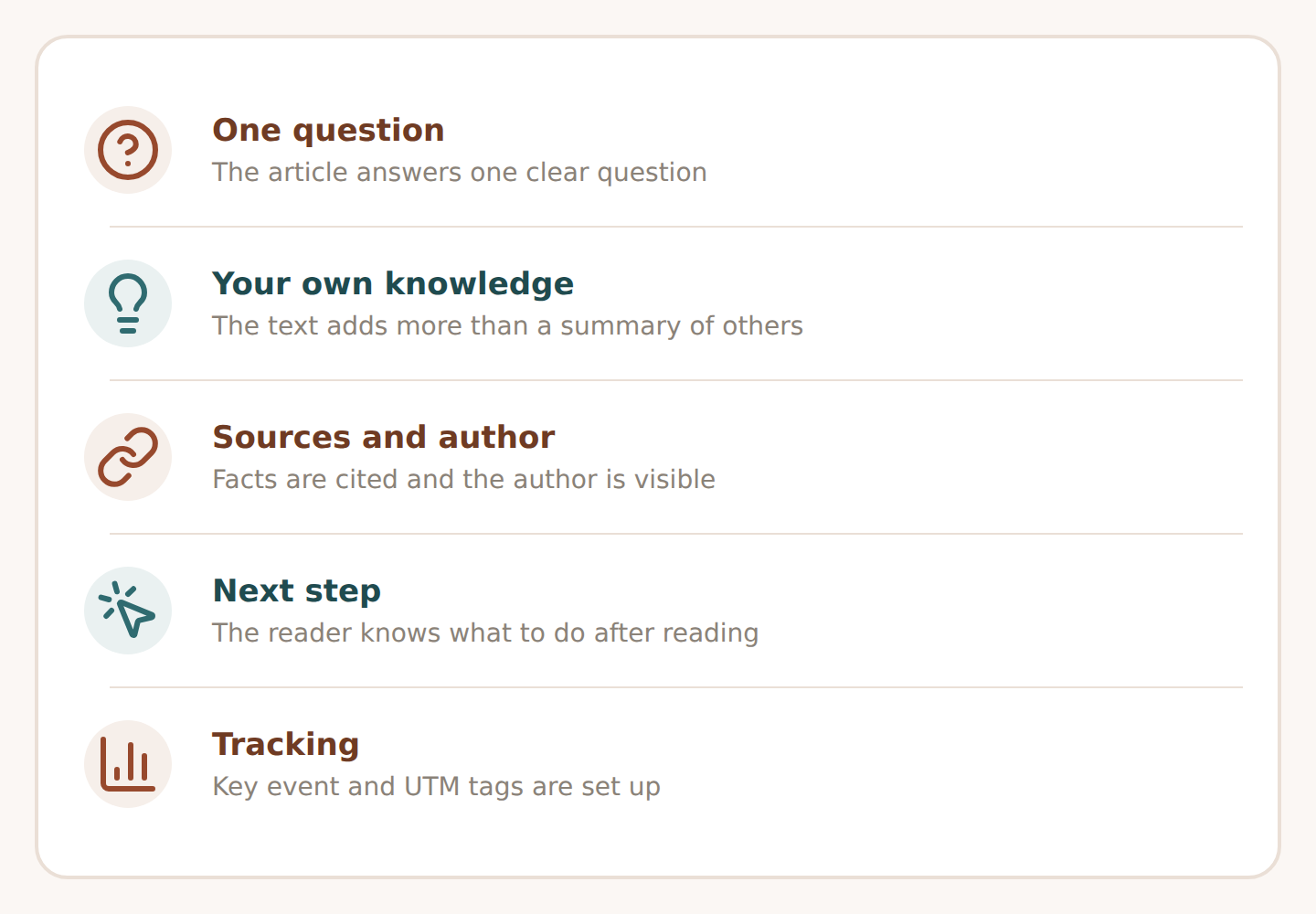
Set up tracking before you publish, because past visits can’t be measured afterwards.
What to track in content marketing
Start with Search Console. The Performance report shows clicks, impressions, CTR and average position in Google Search. You can split the data by queries, pages, countries and devices, and by default the report shows the past three months.
For example: an article gets 300 impressions and one click a month. Then the problem is probably the title or description, not the topic. If there are almost no impressions, first check whether the page is indexed and whether it matches the query.
The other half is action on the page. A GA4 key event measures an action that matters to your business, such as a form submission. You can also create Google Ads conversions from key events, which makes the numbers in the two systems more consistent. I track actions that really succeeded and check that the event doesn’t fire too early.
Add UTM parameters to newsletter and social media links so GA4 can see where the visitor came from. The UTM builder helps with this, and a more technical explanation is in the article UTM parameters.
How to use AI in content marketing
AI speeds up the work, but you remain responsible for the text. Under Google’s spam policy, making many pages mainly to influence search rankings without helping the reader is a violation. How the content is made doesn’t change that. Google’s guidance advises being honest with readers when automation played a large part in creating the text.
On my own site, AI may only create drafts. Publishing stays with a person, the text is reviewed first and facts must come from a verifiable source.
Frequently asked questions
How often should a small business publish content?
Google doesn’t give a fixed frequency. The guidance stresses usefulness and warns against covering many topics just for search visits. Choose a rhythm you can keep up, where each article answers one question.
Is AI-made content allowed on Google?
Under Google’s spam policy, making many pages mainly to influence search rankings is a violation, however the content is made. So usefulness and checked facts matter, not the tool.
Does content marketing replace advertising?
They do different jobs. Ads reach people who are searching or who are shown the ad. Content answers questions even without an ad budget. If you use both, plan them together, for example in a digital marketing strategy.
If you need help choosing content topics, setting up tracking or connecting ads and content, see my services.
Sources
- Google Search Central: Creating helpful, reliable, people-first content
- Google Search Central: SEO Starter Guide
- Google Search Central: Spam policies for Google web search
- Search Console Help: Performance report (Search results)
- Analytics Help: About key events
Facts checked against official documentation on 2 October 2026.